 York Illustrated

The display of three-dimensional signs outside commercial premises became common in English towns and cities during the Middle Ages. This article explains why.
Before houses were numbered (and before some streets even had names), directions were often given in relation to major buildings, the homes of locally well-known individuals or other prominent landmarks. For example:
- "it's opposite the church", or
- "adjoining the tavern", or
- "next to the house of Dr Smith", or
- "turn right beside the big oak tree".
The British Museum collection includes a couple of trade cards that provide 'real world' examples of the first two phrases (see Images 1 and 2 below). Unfortunately, this system had significant limitations, especially in densely packed urban areas when trying to direct people who were not familiar with the neighbourhood (many of whom may not have been able to read or write). In a bid to overcome this difficulty, the occupants of commercial premises often attached a clearly identifiable and locally unique pictorial sign or three-dimensional symbol to the front of their building, then gave directions referencing those symbols. For example: "down the alley at the sign of the Printing Press", which references the Printer's Devil (a.k.a. Little Red Devil) Carving on Stonegate (see top-left of Image 3).
Image 1
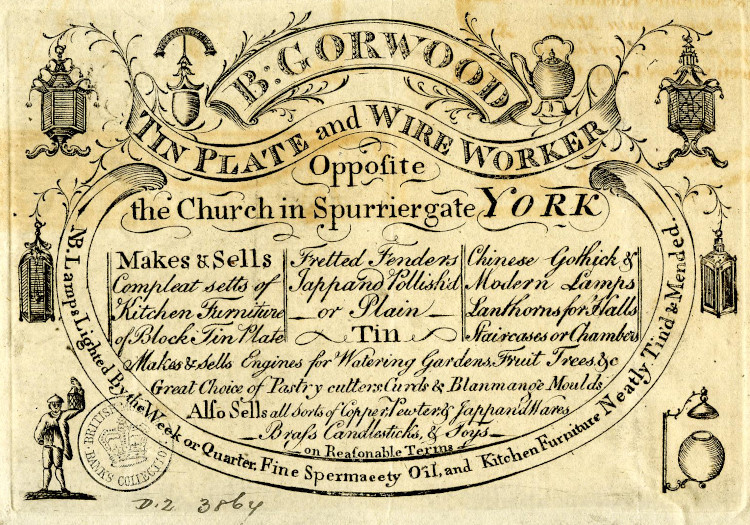
"B. GORWOOD
TIN PLATE and WIRE WORKER
Opposite
the Church in Spurriergate, YORK."
© The Trustees of the British Museum (asset no. 404574001 - see footnote 1).
Image 2

"WILKINSON
HATTER
HOSIER & GLOVER
adjoining the Tavern
ST HELEN'S SQUARE
YORK."
© The Trustees of the British Museum (asset no. 1042390001 - see footnote 2).
Image 3
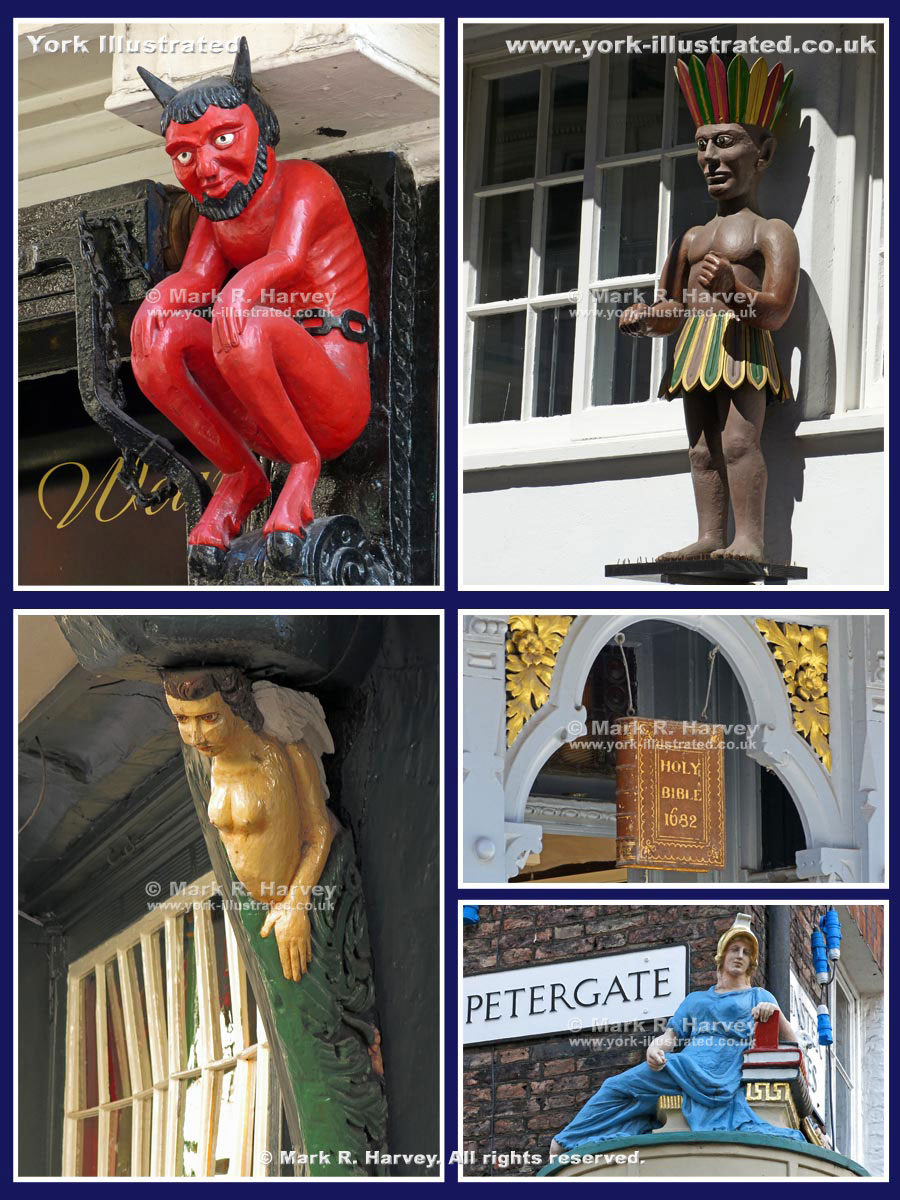
The display of three-dimensional signs outside shops, workshops, inns and other trading establishments became common in English towns and cities during the Middle Ages. Many of these signs depicted the goods that were being sold from - or manufactured on - the premises (e.g. a boot for a cobbler or a horse shoe for a farrier). Minerva on the corner of High Petergate and Minster Gates is a good example of this type of three-dimensional symbol. However, symbols were also chosen for a wide variety of other reasons. Some were connected with the owner's name. Others were selected primarily to be different, to stand-out, to be easily identified from a distance and / or to be easily remembered (similar to modern-day commercial branding).
During the 16th and 17th centuries, the circulation of books and other printed works increased significantly and literacy levels began to improve. However, a large proportion of the general population were still unable to read with confidence and the lack of effective street lighting meant that signs were difficult to see clearly in the dark. As a consequence, large three-dimensional symbols continued to be a more effective method of identifying and promoting businesses than written signs. During this period there was a fashion for increasingly ornate, brightly painted and / or gilded signs and the 'Holy Bible 1682' sign (also on Stonegate) is a relatively simple example of the latter. The need for businesses to display three-dimensional symbols diminished slightly in 1782, when York City Corporation began fixing street names to the sides of buildings on street corners in the central area of the city. However, three dimensional symbols remained popular as they could be quickly and easily recognised by almost everyone.
During the mid to late 19th century, literacy levels improved, house numbering became the norm and relatively cheap text-based signs became commonplace. Despite this, the tradition of using symbols continues into modern times. Common examples include traditional red & white barber's poles, the three gold balls associated with pawnbrokers, the pictorial signs displayed outside most 'traditional' British pubs and the ubiquitous adoption of corporate logos and instantly recognisable 'brand identities'.
Footnotes
[1] This image is a 'derived work' based on a digital image file downloaded from the British Museum's online catalogue, which can be accessed via the following external link:
https://www.britishmuseum.org/collection
To create the version used on the York Illustrated website, the image was trimmed and resized. The original image and this version are both © The Trustees of the British Museum and both are subject to the CC BY-NC-SA 4.0 license - see:
http://creativecommons.org/licenses/by-nc-sa/4.0/
[2] This image is a 'derived work' based on a digital image file downloaded from the British Museum's online catalogue (see footnote 1). To create the version used on the York Illustrated website, the colour temperature was adjusted, then the image was trimmed and resized. The original image and this version are both © The Trustees of the British Museum and both are subject to the CC BY-NC-SA 4.0 license - see:
http://creativecommons.org/licenses/by-nc-sa/4.0/