 York Illustrated
The painted wooden carving known locally as 'the American Indian' was originally created to identify and promote a tobacconist's business at 76 Low Petergate.
This interesting figure (see Image 1) takes the form of a short stout Native American male wearing a kilt and headdress. From a quick glance, it is easy to assume that the headress is adorned with feathers. However, the shapes adorning both garments are actually stylised depictions of air‑cured tobacco leaves (see Images 2 & 3). Depictions of human figures wearing and / or holding tobacco leaves have been used to promote tobacco-related products for more than three centuries (see Image 4 for an early printed example). The association between tobacco products and American Indians began during the 16th century, when native American people introduced European explorers to the habit of smoking tobacco leaves. The link was subsequently exploited by tobacco traders seeking to promote the 'exotic' nature of their products.
Image 1
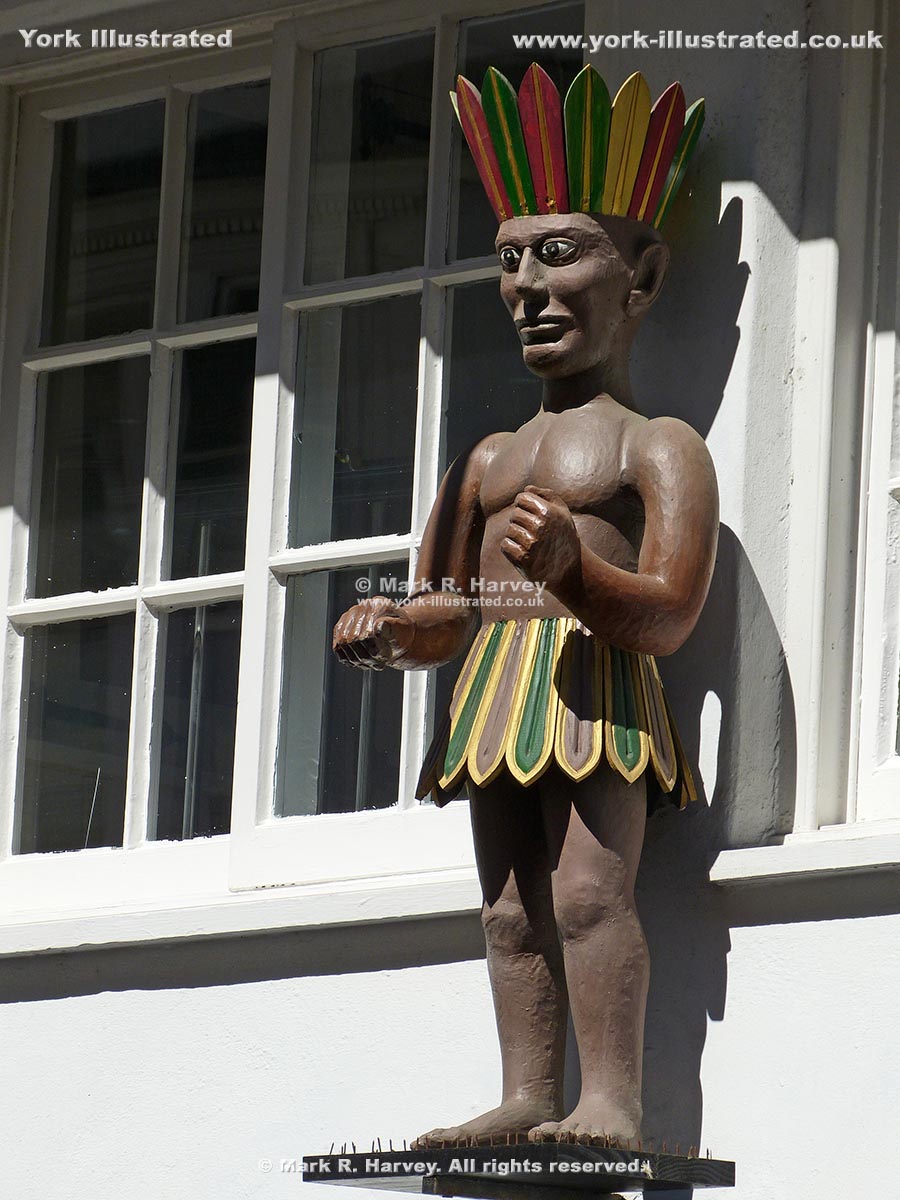
A photograph of the American Indian Carving on a shelf above the shopfront of number 76 Low Petergate (York). Note the stylised tobacco leaves forming his headdress and kilt. Over the years, these have been painted in a number of different colours.
Image 2
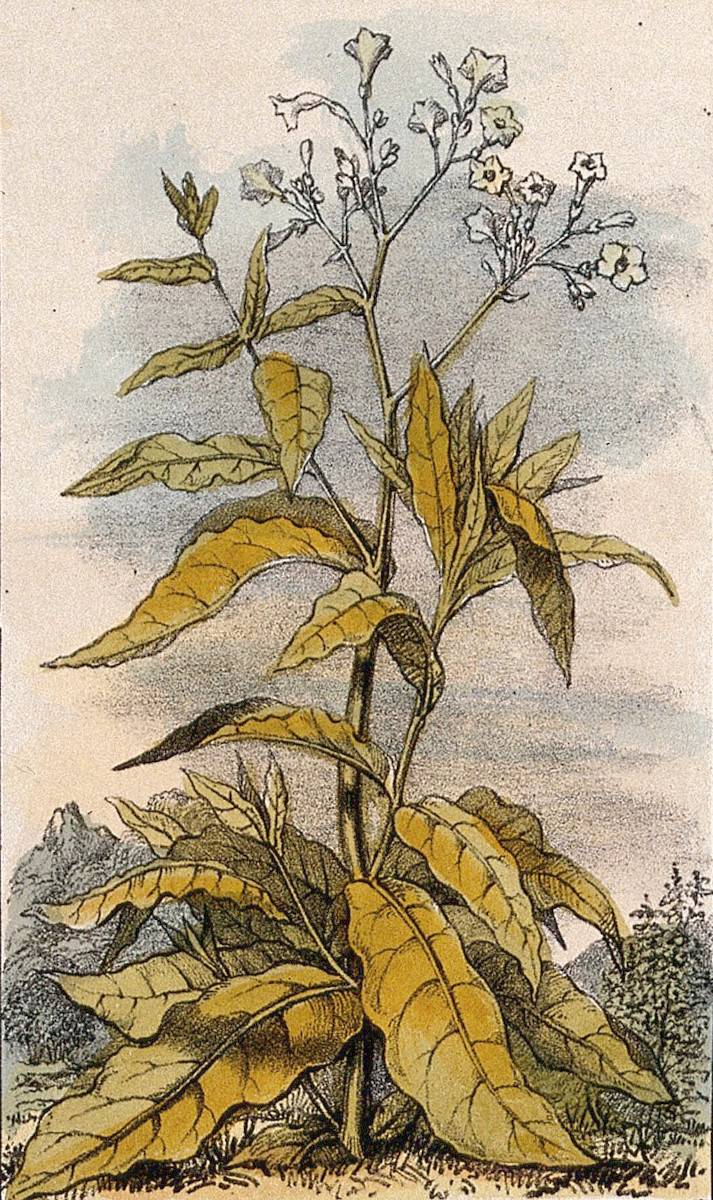
The shape of the leaves and their prominant veining gives them the appearance of a simplified feather.
Public Domain image - see footnote-1.
Image 3

Public Domain image - see footnote 2.
Image 4
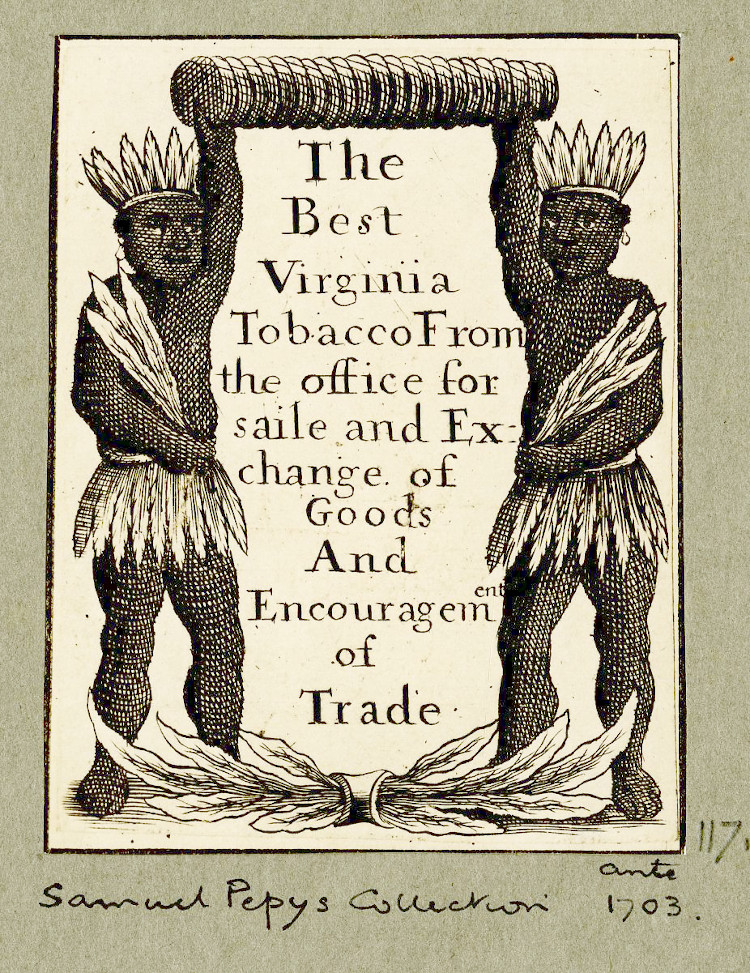
© The Trustees of the British Museum (asset no. 1505417001 - see footnote 3).
For a brief explanation of why three-dimensional symbols like this one were once commonplace in towns and cities, see the brief article 'Giving directions before the advent of standardised addresses'.
A brief (and very incomplete) 'biography'
- The date of this American Indian's first public appearance is something of a mystery. Some sources suggest that he first appeared 'during the 18th century', while others suggest a date of circa 1800. Either way, he has since become a well-liked local landmark.
- According to the caption for a black & white photograph in the York Press collection, he was repainted in 1978 by Fred Parker (see footnote 4).
- In March 2001, he was stolen and, despite appeals in the local press for his safe return, a replica had to be created. The task was undertaken by Dick Reid (a local master carver based in Fishergate) and the replacement was installed in December 2002.
- The replacement was repainted (or partially repainted) at some point between November 2011 and August 2016. (Photographs from these dates show differences in the colours used for the leaves of his headress: alternating green, red, yellow and blue in 2011, but alternating green, red and yellow in 2016.)
- In August 2016, he was damaged (probably by a passing lorry). His hands were knocked off, along with the front part of his shelf. Fortunately, help was soon at hand (!) to carry-out the required repairs.
Footnotes
[1] This image is a 'derived work' based on a digital image file downloaded from the Wellcome Collection via the following external link:
https://wellcomecollection.org/works/xyxxmtru
To create the version used on the York Illustrated website, the original image was cropped (to isolate the tobacco plant from five additional tobacco-related 'scenes'), the levels were adjusted and the image was resized. Both the original image and this derived version are believed to be in the Public Domain - see. https://creativecommons.org/share-your-work/public-domain/pdm/.
[2] Source: Page 95 of "Tobacco: growing, curing, & manufacturing. A handbook for planters in all parts of the world" by C. G. Warnford Lock (published by E. & F.N. Spon, London, 1886). The copyright on this publication has expired and, based on its date of publication, the illustration used as the base for Image 3 is believed to be in the Pubic Domain.
[3] This image is a 'derived work' based on a digital image file downloaded from the British Museum's online catalogue, which can be accessed via the following external link:
https://www.britishmuseum.org/collection
To create the version used on the York Illustrated website, the colour temperature and levels were adjusted and the image was resized. The original image and this version are both © The Trustees of the British Museum and both are subject to the CC BY-NC-SA 4.0 license - see:
http://creativecommons.org/licenses/by-nc-sa/4.0/
The text on the image reads:
The Best Virginia Tobacco From the office for saile and Ex-change of Goods and Encouragement of Trade.
The handwritten note on the backing card below the image reads:
Samuel Pepys Collection ante 1703.
[4] At the time of writing, the photograph could be viewed via the following external link:
https://www.yorkpress.co.uk/news/14509291.50-old-photos-of-high-low-petergate-in-york/#gallery18