 York Illustrated
The Blue Bridge is a manually-operated double-leaf bascule footbridge across Browney Dyke (a section of the Foss Navigation near the River Ouse in York).
Image 1
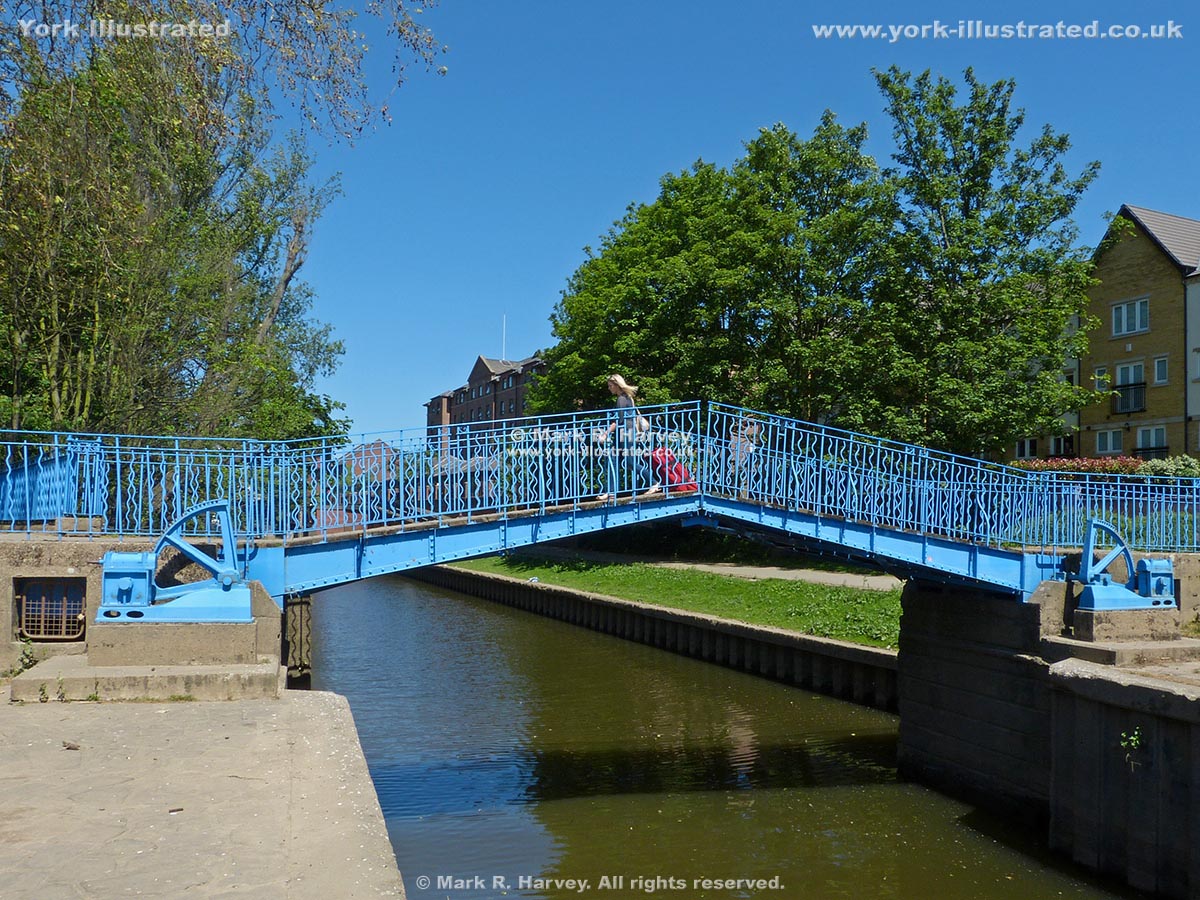
Image 2
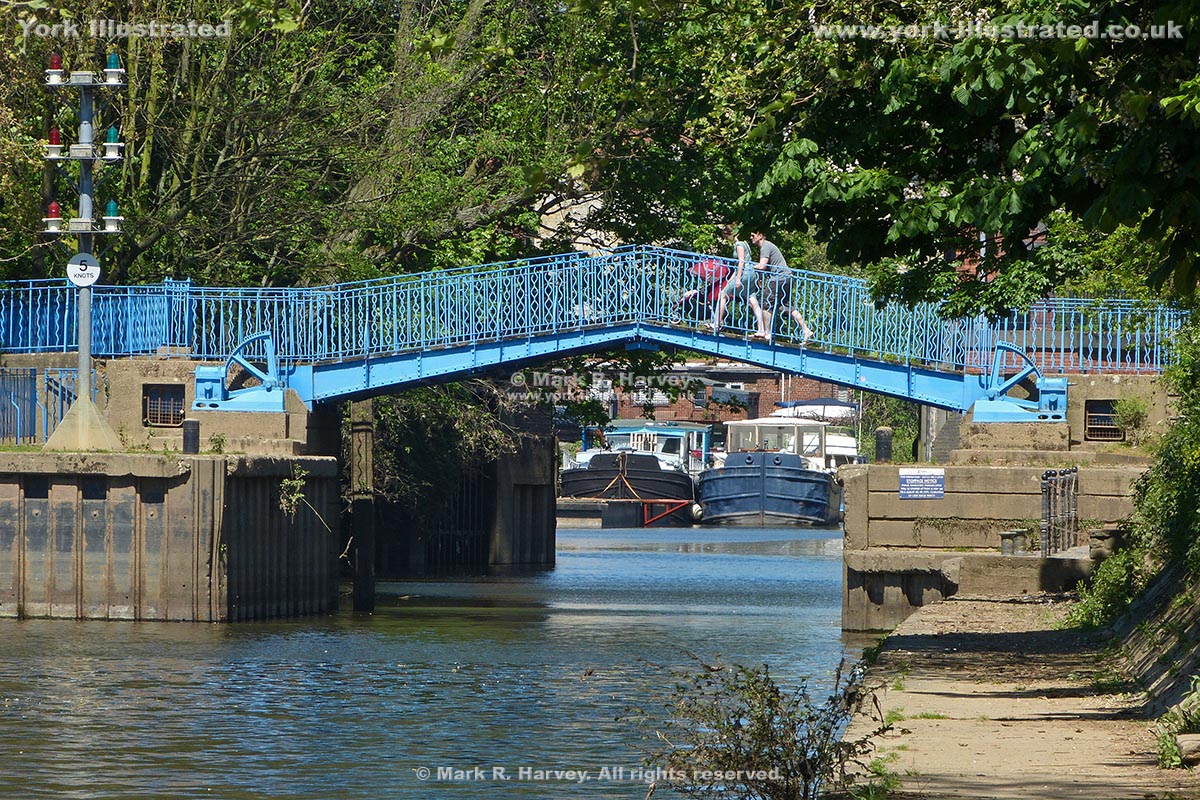
Image 3
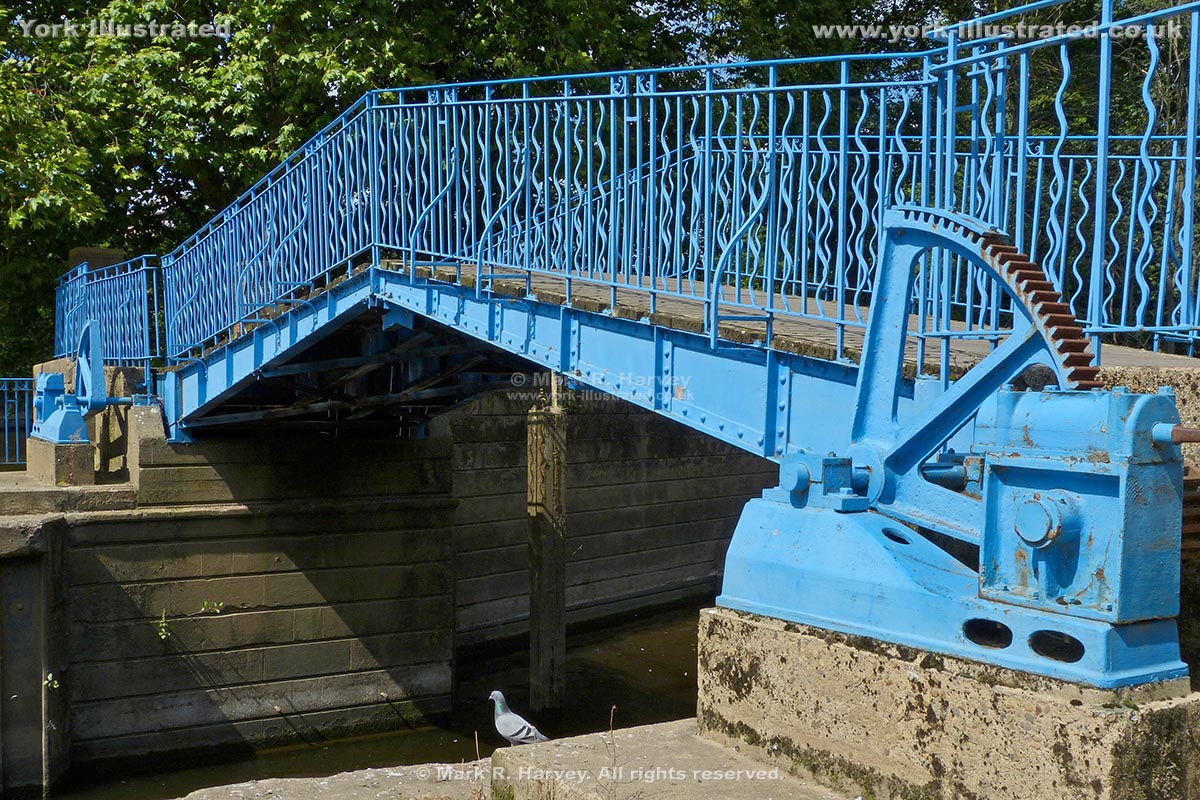
Image 4
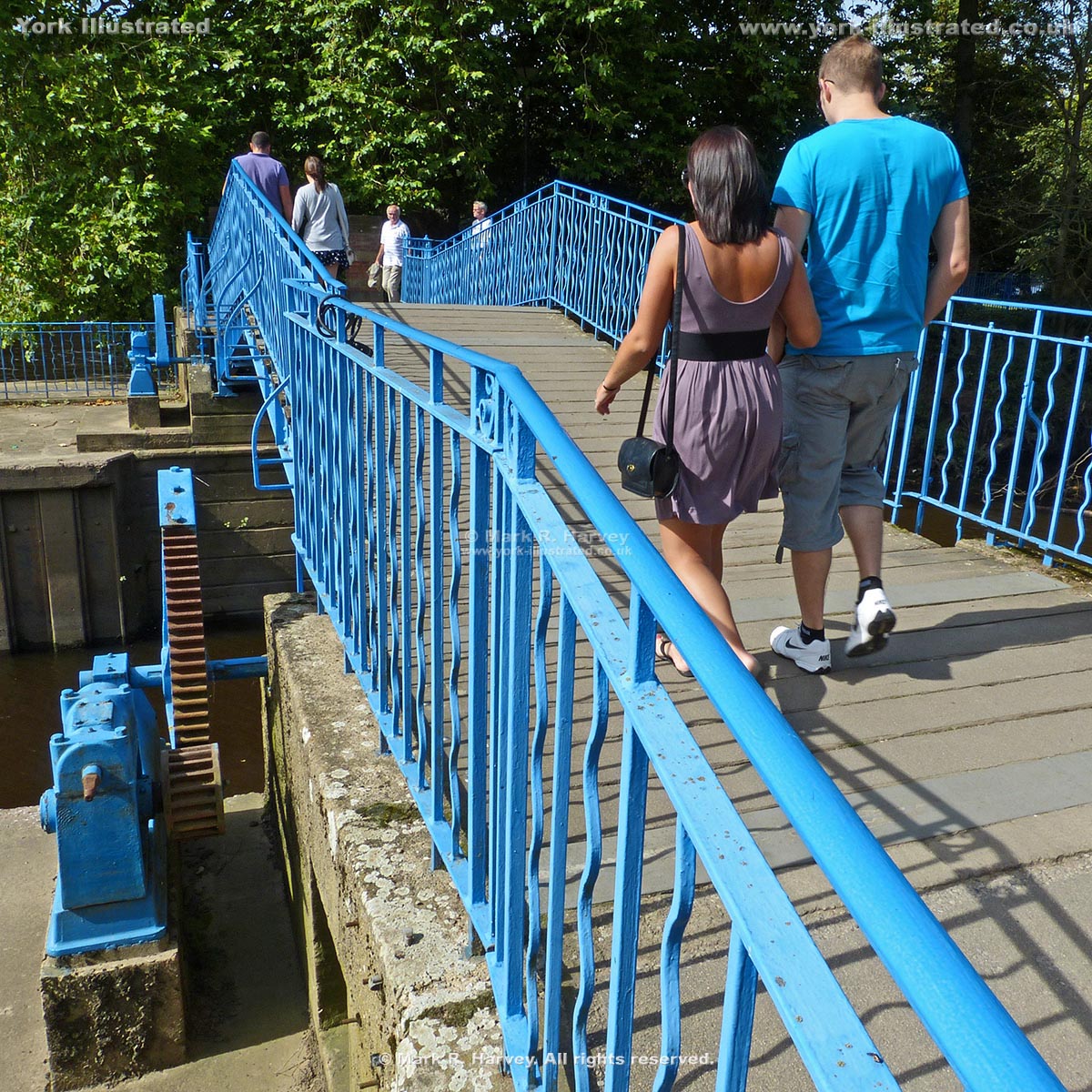
Image 5

The bridge gets its name from the first bridge ever built on the site: a small wooden blue-painted drawbridge that was constructed in 1738. (For a partial view of the original Blue Bridge, see Images 7 & 8 on the New Walk page.) The blue paint does not seem to have protected the wood for very long as the bridge was replaced by a stone bridge just 30 years later. In 1801, the Foss Navigation Company replaced the stone bridge with a wooden swing bridge to provide additional clearance for boats entering and leaving Foss Basin.
1834 saw this wooden bridge being replaced with another of the same type.
Wooden bridges do not seem to have fared well in this location as, in 1857 the second swing bridge was replaced with an iron two-leaf lifting bridge. Photographs of this structure can be accessed online courtesy of the Explore York Images Collection via the following external links:
- Catalogue reference: 1000676
https://images.exploreyork.org.uk/Respages/Search.aspx?stype=2&sword=1000676 - Catalogue reference: 1003266
https://images.exploreyork.org.uk/Respages/Search.aspx?stype=2&sword=1003266 - Catalogue reference: 1000175
https://images.exploreyork.org.uk/Respages/Search.aspx?stype=2&sword=1000175 - Catalogue reference: 1000173
https://images.exploreyork.org.uk/Respages/Search.aspx?stype=2&sword=1000173 - Catalogue reference: 1000174
https://images.exploreyork.org.uk/Respages/Search.aspx?stype=2&sword=1000174
The current 'Blue Bridge' is the sixth bridge on the site and it was built in 1929-30. It is still operational and each of its two 'bascules' can be lifted independently via the winding mechanisms located either side of the river.
It earns its two-star rating because children may find the theory of its operation fascinating and because it offers a clear view of the Foss Barrier and a glimpse across the Foss Basin to the Inner Bailey Walls and South Angle Tower of York Castle beyond. (From this angle, it is much easier to image how the castle would have looked when it was surrounded by its moat.)
The 'Blue Bridge' forms part of the New Walk (a pleasant and popular walking / cycling route that runs along and immediately adjacent to the eastern bank of the River Ouse).