 York Illustrated
The New Walk is a ¾ mile (1.2 km) long riverside footpath and cycle route linking Tower Gardens and the South Esplanade with the Millennium Footbridge.
It is an extension of an earlier tree-lined riverside promenade known as "The Long Walk", which was constructed circa 1730-32 to allow the leisured classes to 'take the air' and socialise.
Image 1
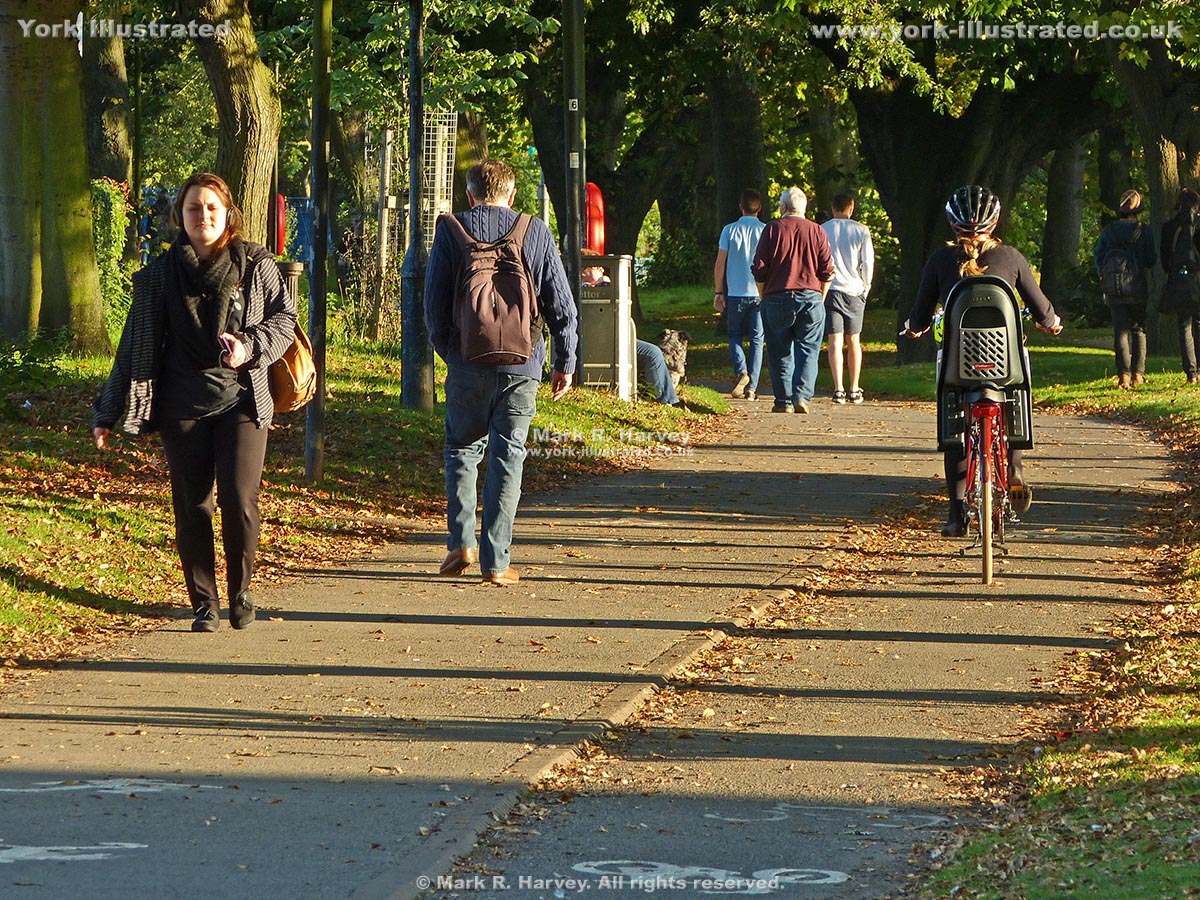
Take care when using this path as pedestrians and cyclists rarely stay on the correct side.
Image 2
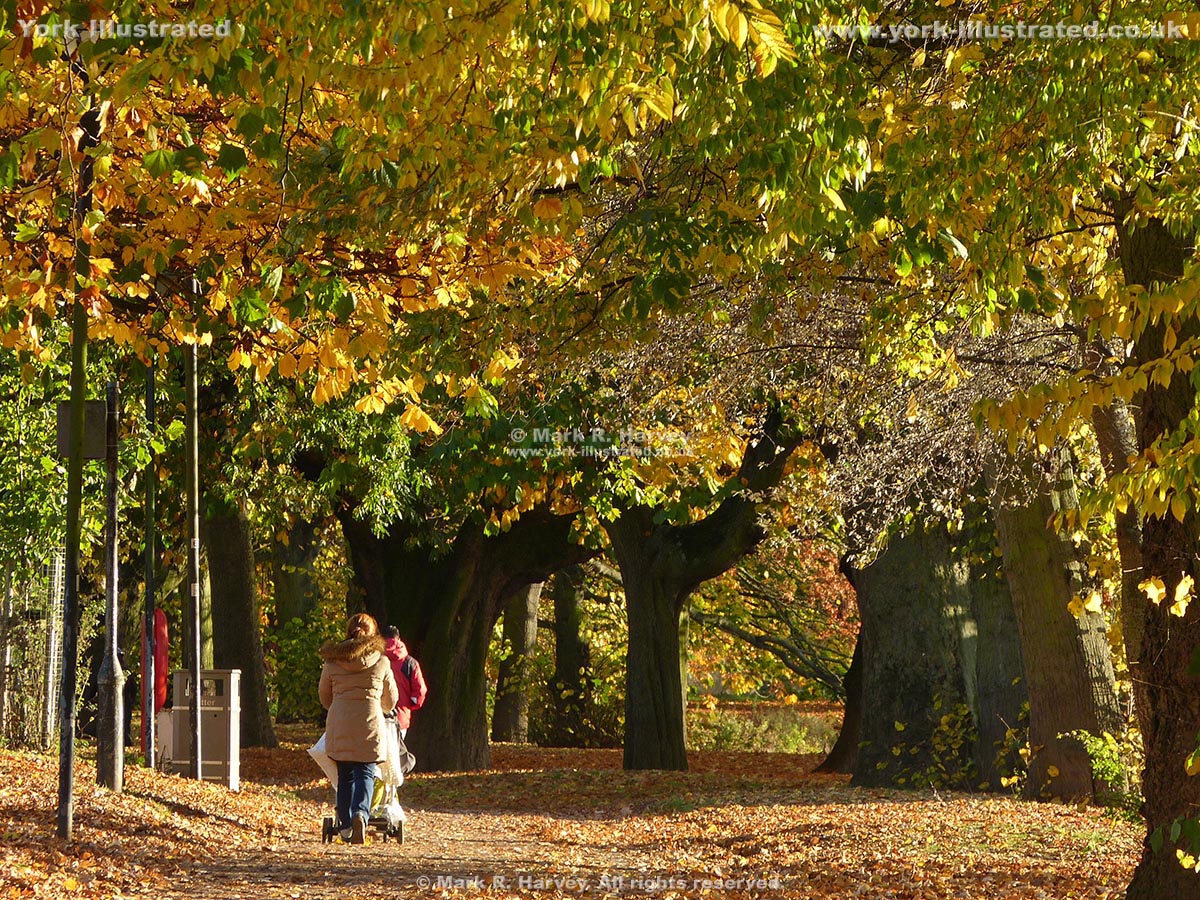
Image 3
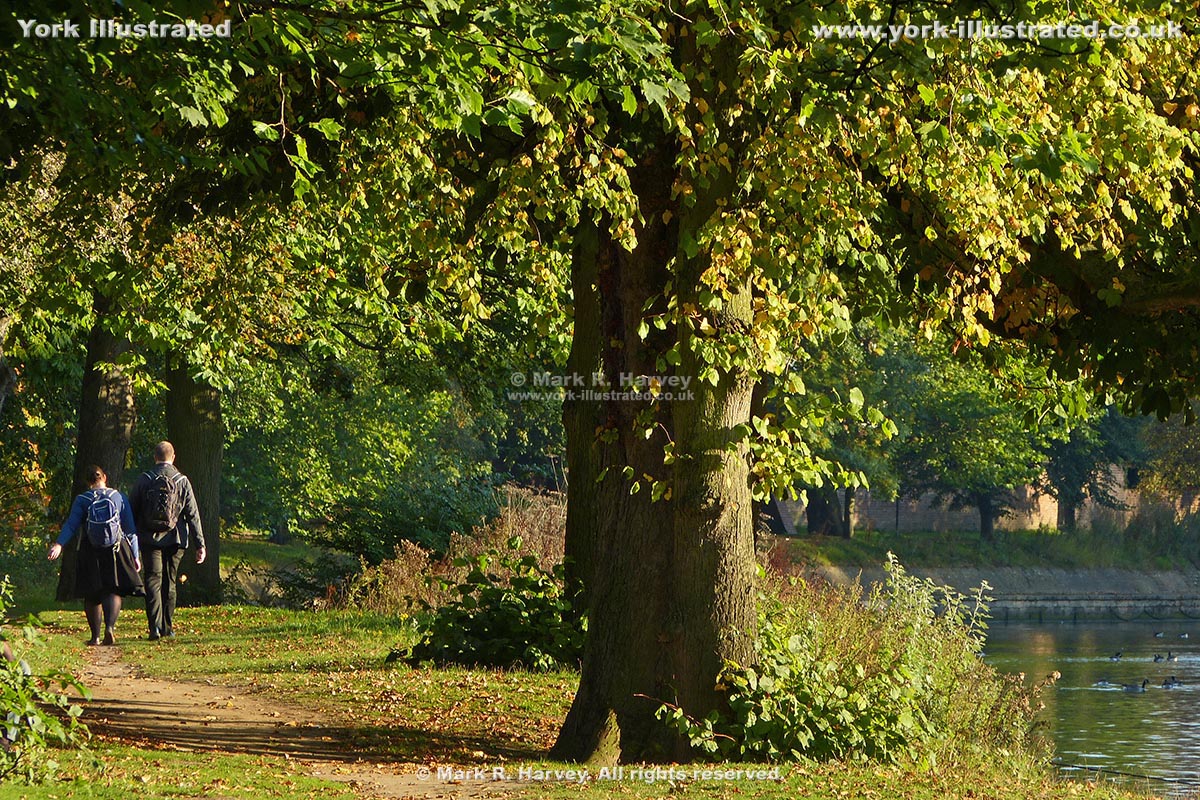
Image 4
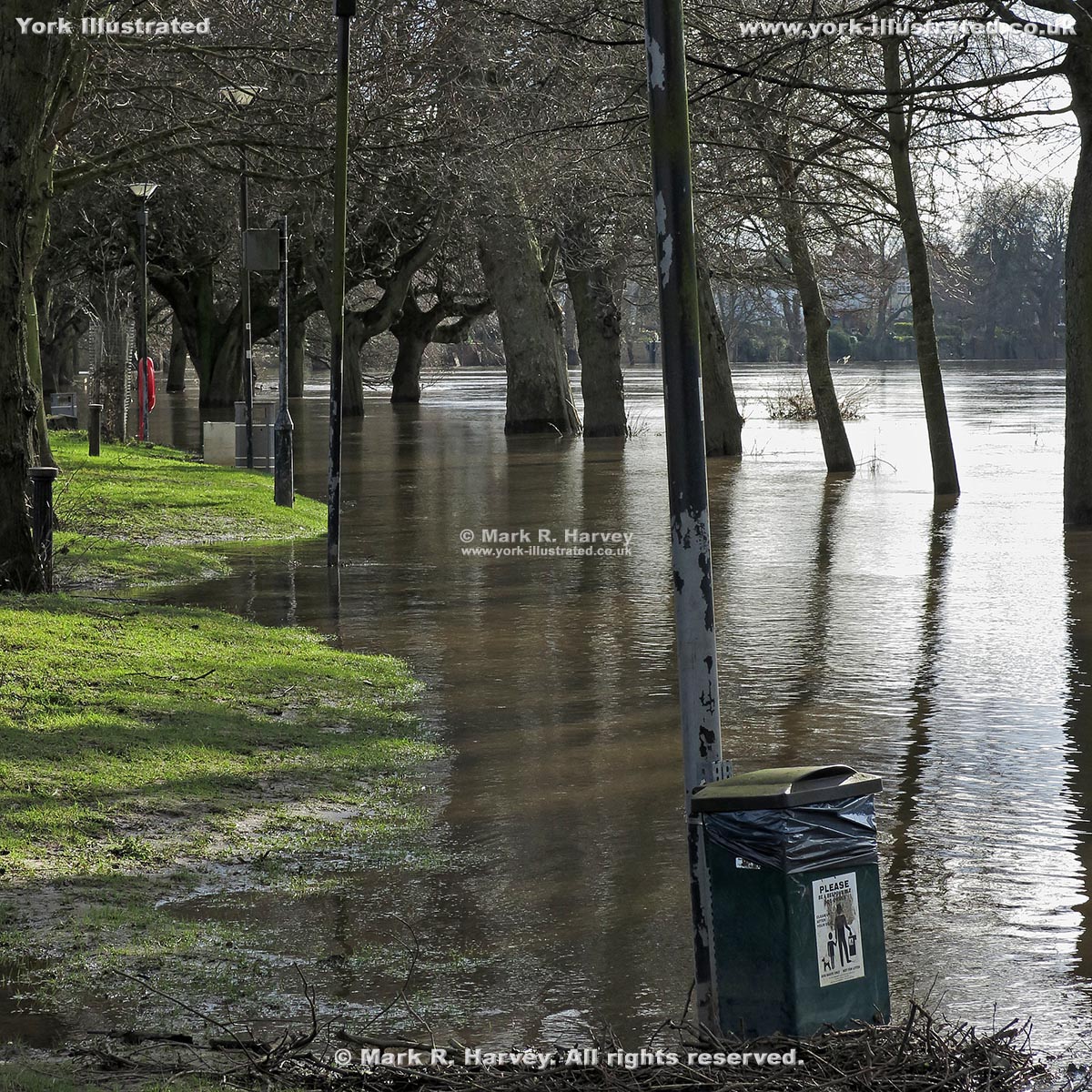
Image 5
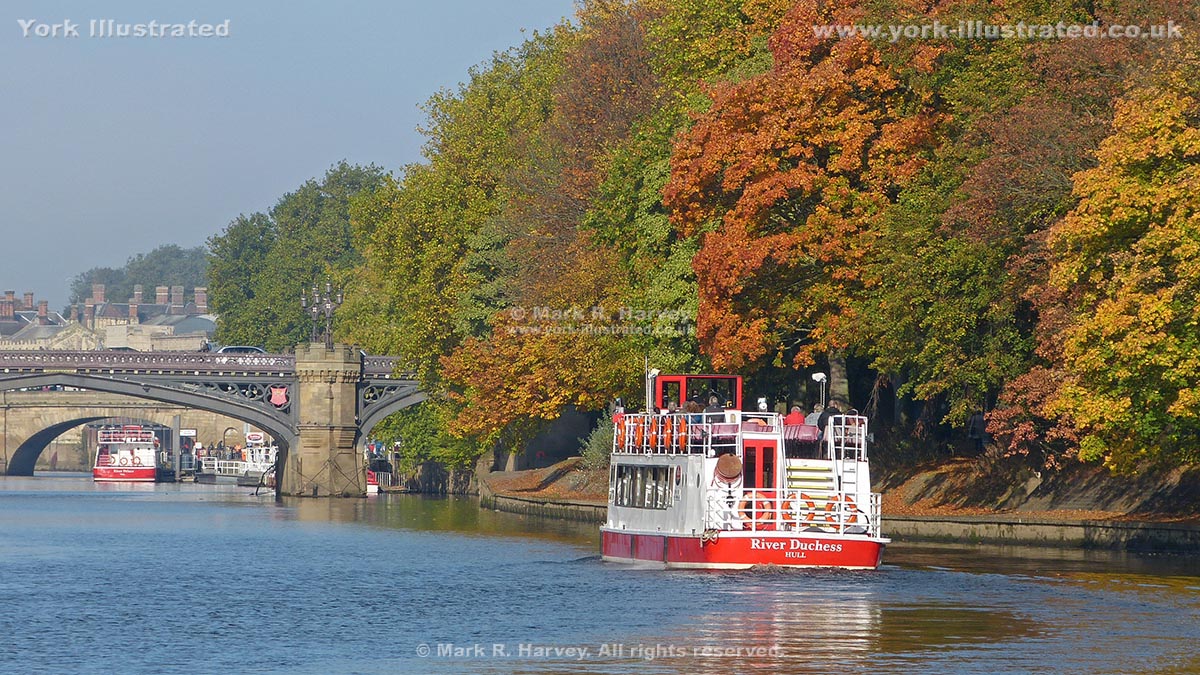
Image 6

A small parcel of land beside the New Walk (bottom-right) and the Blue Bridge (centre) has been turned into a wildflower garden. This image (taken at the end of May 2017) shows the garden in full bloom. For a partial view of the original Blue Bridge, see Image 8.
Image 7
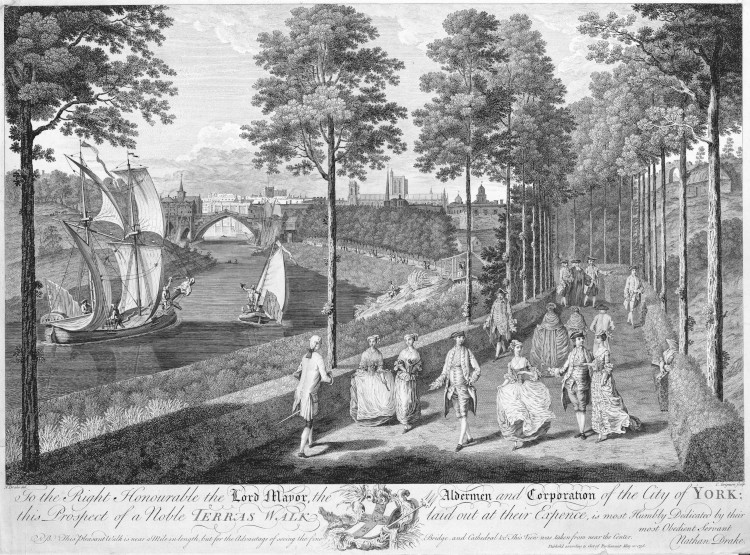
An artist's impression (circa 1756) of the "New Terrace Walk" (foreground) and "The Long Walk" (centre-left, leading the eye towards the old Ouse Bridge). These two paths are now collectively known as the "New Walk".
©The Trustees of the British Museum (asset no. 854574001 - see footnote 1).
Image 8
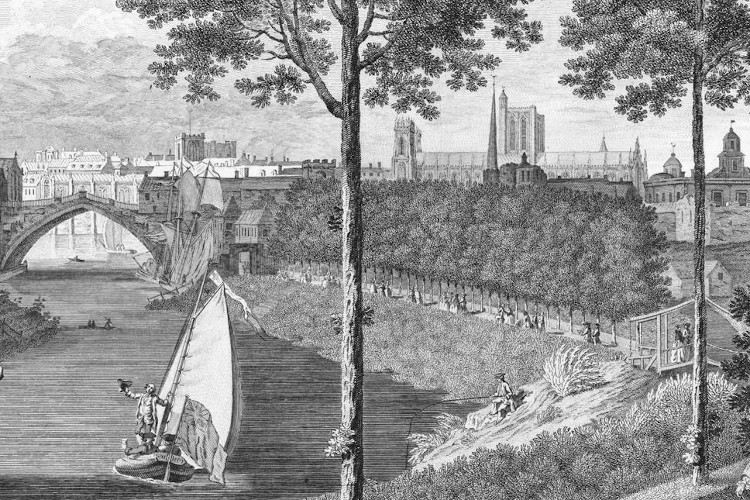
A crop from the central area of the file used for Image 7, showing "The Long Walk" and the gated archway through the City Wall leading to / from what is now known as the South Esplanade. The small footbridge (extreme right) was built to carry the extended riverside path across the River Foss. It was painted blue, so it became known as the Blue Bridge.
©The Trustees of the British Museum (asset no. 854574001 - see footnote 1).
A brief history
In his 1736 publication "Eboracum: or the History and Antiquities of the City of York”, the historian Francis Drake describes the starting-point of this promenade as follows:
"Below the King's stayth, is a place of that kind of stone work called Friars walls [2]; which is a long raised walk built, or rebuilt anno 1659, with a brick wall towards the water. At the end of this walk is a handsome iron palisade gate, in a stone arch [3], erected as an inscription shews anno 1732, Jonas Thompson lord-mayor. This leads to the long walk already described."
The Long Walk then ran southwards alongside the River Ouse until it reached the confluence with the River Foss, a distance of approximately 480 yards. When originally constructed, the promenade consisted of an eight foot wide gravel-covered path, with a single row of evenly-spaced trees on the landward side (see Images 7 & 8).
The promenade proved to be extremely popular and the City Council quickly decided to extend it by three-quarters of a mile. This entailed building a new bridge over the River Foss in 1738 (the original Blue Bridge) and creating a new gravel-covered path beside the river. The path was twenty feet wide and it was bordered on both sides by a low hedge incorporating a row of evenly-spaced trees (see Image 7). This extension to "The Long Walk" was initially referred to as "New Terrace Walk" but, by the early nineteenth century, the full length of the promenade was being referred to as the "New Walk".
In his 1818 publication "History and Description of the Ancient City of York . . .", William Hargrove describes the 'New Walk' as follows:
"The walk is interspersed with garden seats, placed at convenient distances; and on summer evenings a full regimental band, often attends from the neighbouring barracks, and amuses the company with martial music; the interest of which is heightened by the soft echoes of wood and water, which die away on the passing breeze."
Over the years, many of the original trees have been replaced and a large number of additional trees have been planted, giving this delightful riverside walk a woodland atmosphere.
These days, you are unlikely to be serenaded by a brass band as you stroll along the New Walk. However, there are still a few seats that will allow you to pause for a while to enjoy the 'wood and water'.
Practical Information
The New Walk forms part of a pleasant 1.5 mile circular walk from Skeldergate Bridge (near Tower Gardens and Clifford's Tower) via the Millennium Bridge, Rowntree Park and Terry Avenue. However, please note that this entire walking route lies within the functional flood plain of the River Ouse (see Image 4) and that it may be inaccessible when the river is in flood and for the duration of any post-flood clean-up works. If you are planning a real-world visit, you may wish to bear in mind this Riverside Walk Safety Advice.
Footnotes
[1] Images 7 & 8 are 'derived works' based on a digital image file downloaded from the British Museum's online catalogue, which can be accessed via the following external link:
https://www.britishmuseum.org/collection
To create the versions used on the York Illustrated website, the original image was trimmed, desaturated and resized (Image 7), then cropped to focus on the central area (Image 8). The original image and these two versions are all © The Trustees of the British Museum and they are all subject to the CC BY-NC-SA 4.0 license - see:
http://creativecommons.org/licenses/by-nc-sa/4.0/
The original image is a print of an engraving by Charles Grignion derived from a painting by Nathan Drake. The text printed below the original image is as follows:
N. Drake del
C. Grignion sculp.
To the Right Honourable the Lord Mayor, the Aldermen and Corporation of the City of YORK; this Prospect of a Noble TERRAS WALK laid out at their expence, is most Humbly Dedicated by their most Obedient Servant Nathan Drake.
N.B. This Pleasant Walk is near a Mile in length, but for the Advantage of seeing the fine Bridge, and Cathedral &c. This View was taken from near the Center.
Publish'd according to Act of Parliament May 10: 1756.
[2] The 'raised walk' 'Below the King's stayth' which Drake refers to as 'Friars walls' is now known as the South Esplanade.
[3] The new gated archway through the City Walls was located between Davy Tower and the River Ouse. According to Drake, it was known as "the Long-Walk Postern". Unfortunately, there is no longer any trace of either the postern, or the short section of City Wall that once linked Davy Tower with the river bank. However, both are clearly visible in the full-size version of the painting by Nathan Drake (see Image 7).