 York Illustrated
Monk Bar is the tallest and strongest of the York's four main gateways. It was built in the 14th - 15th centuries to protect the city's northeastern approaches.
Like the other three main gateways ('bars'), Monk Bar was constructed with a barbican on the outer face, but this was removed in 1825/6. The two doorways with closed studded wooden doors at first-floor level (visible in Image 1) originally led onto the walkway that ran around the top of the barbican.
At third-floor level, the front wall of the Bar projects forward above a pointed-arch (see images 1 and 2). This allowed boiling oil, human / animal waste, rocks, and other painful or unpleasant things to be dropped on the heads of anyone attacking the portcullis.
The outer face of the Bar also features:
- A pair of castellated turrets, each topped with three stone statues. These statues all take the form of the upper torso of a man holding a boulder, as if ready to hurl it at any approaching attackers.
- Twelve cross-shaped arrow slits with oillets.
- Two small square windows (originally gun ports).
-
Three stone shields (see images 1 and 2), each located directly below a decorated and gilded carved-stone canopy. Each shield bears a coat of arms:
- Top-centre is the royal arms of King Henry IV / King Edward IV (three golden lions on a red field quartered with three golden fleurs-de-lis on a blue field).
- Below and to either side of the royal arms is the arms of the city of York (a white shield overlain with the red cross of St George, the latter being embossed with the five gold passant guardant lions of England).
Image 1
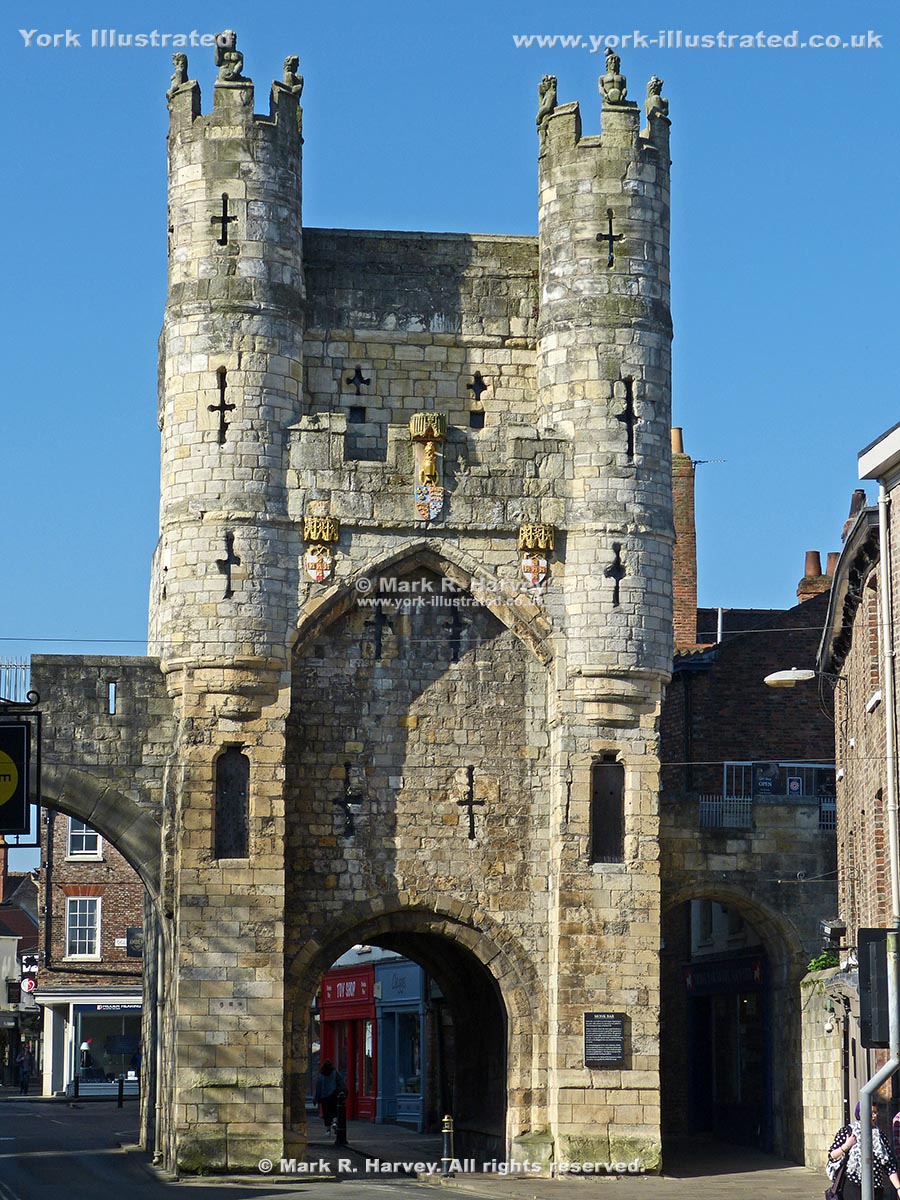
Image 2

Image 3
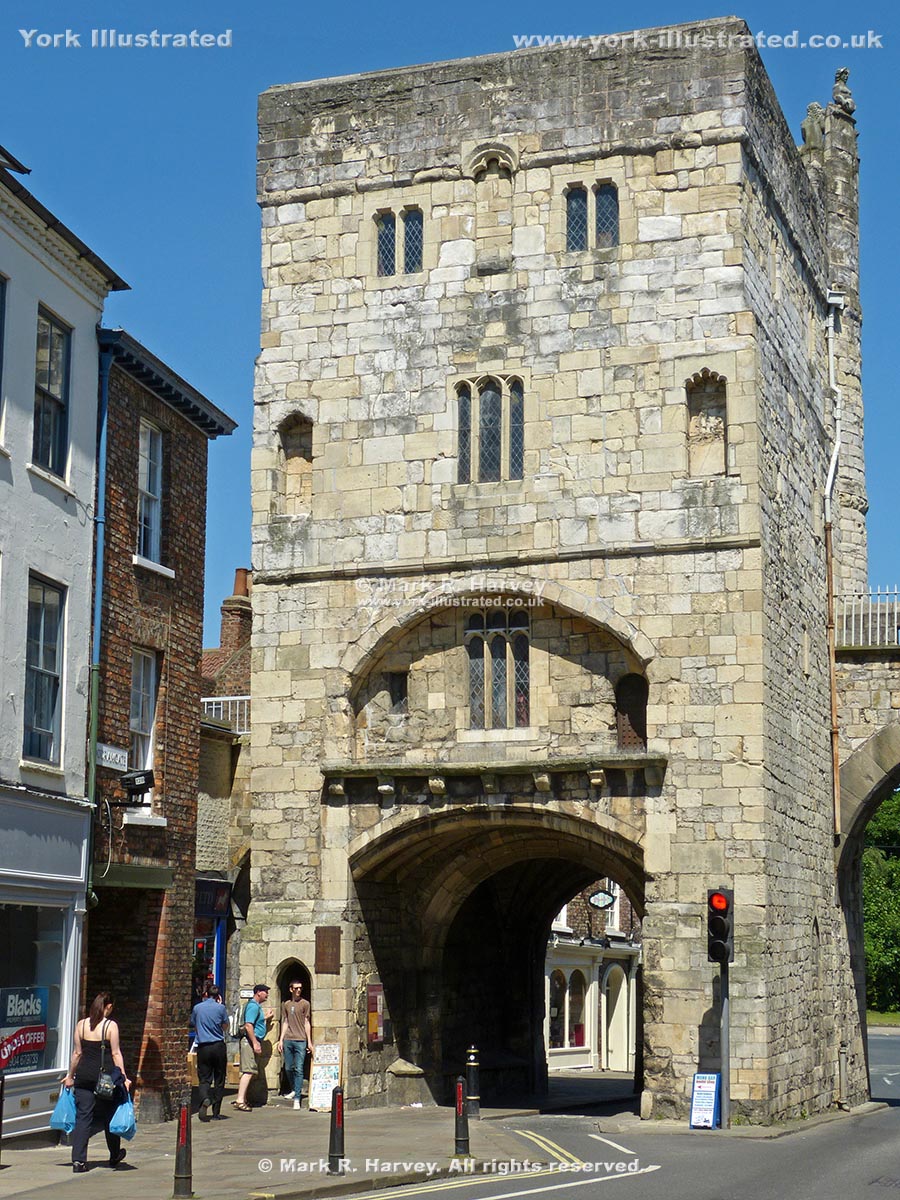
Image 4
Monk Bar is believed to have been the only one of the four main gateways to feature stone walls on all four sides when originally built. (The inner walls of the other three 'bars' are believed to have been either open to the elements, or infilled with timber frames, wattle and daub.)
The lower three storeys of Monk Bar were built in the 14th century. The fourth storey was added in the 15th century.
During the 16th century, Monk Bar was used as a temporary prison known as 'Little Ease'. The cells were small, cramped and extremely uncomfortable - a marked contrast to the larger rooms that provided a home for one of the City's police inspectors between 1845 and 1913.
The staircases between floors are on alternate sides of the building. This design feature, combined with the vaulted stone ceilings, significantly increased the tower's defensive capabilities by forcing any attackers to break-through a narrow doorway, cross from one side of the building to the other, then break through a second narrow doorway to reach the next narrow staircase.
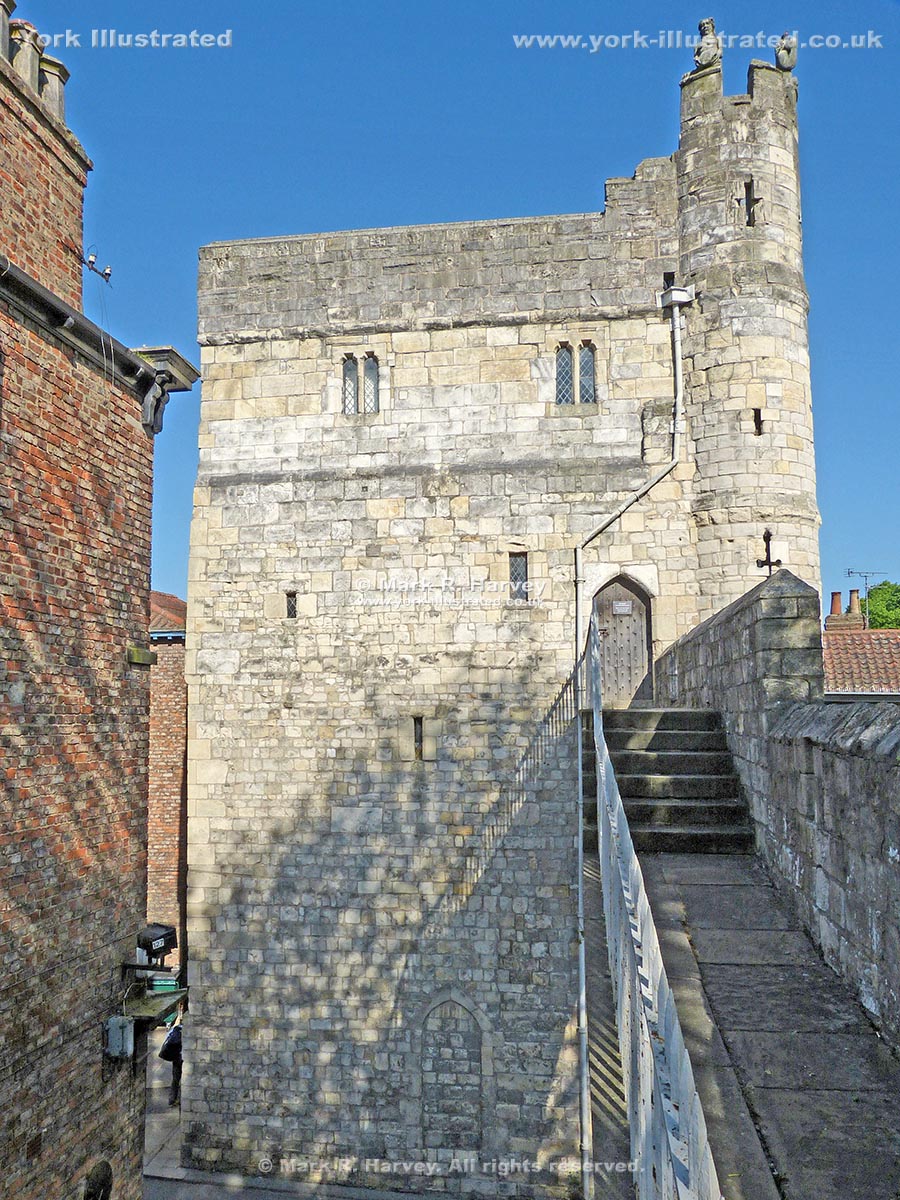
The rear wall (i.e. the southwest elevation) includes an unusual first-floor doorway and stone ledge / balcony (see Image 3). The purpose of this is unknown. One (rather unlikely) suggestion is that it was created simply to allow the windows to be cleaned without the need to obstruct the carriageway below. Alternatively, it may have had some form of ceremonial purpose.
The arches piercing the city wall on either side of Monk Bar were created during the nineteenth century (to reduce traffic congestion).
Practical information
Access steps between road level and the Wall Walk are provided on either side of Monk Bar.
The wall-top walkway does NOT pass through (or along the top of) the Bar building. When walking this section of the wall-top walkway, it is necessary to descend a set of steps to road level, cross the road (carefully), then climb the steps on the other side. (The doorway and short section of wall-top walkway visible in Image 4 are NOT for public use.)
Access to the northernmost section of the Wall Walk (to / from Bootham Bar) is via a steep and narrow stone staircase built within the thickness of the bar's northwest wall. This flight of steps is a fascinating feature in its own right as it lies within the thickness of the Bar's exterior wall (see Image 3). However, as a consequence, this flight of steps is very narrow, very steep and has limited headroom.
Until recently, the upper floors of Monk Bar were occupied by "The Richard III Experience" (a museum dedicated to the last Plantagenet King of England), but this has permanently closed.