 York Illustrated

A set of three access arches were inserted into the city wall by the York and North Midland Railway Company during the second quarter of the 19th century.
They enabled the company to move its passenger and goods facilities closer to the city centre (from a temporary site located on Queen Street, just outside the city walls).
Image A1
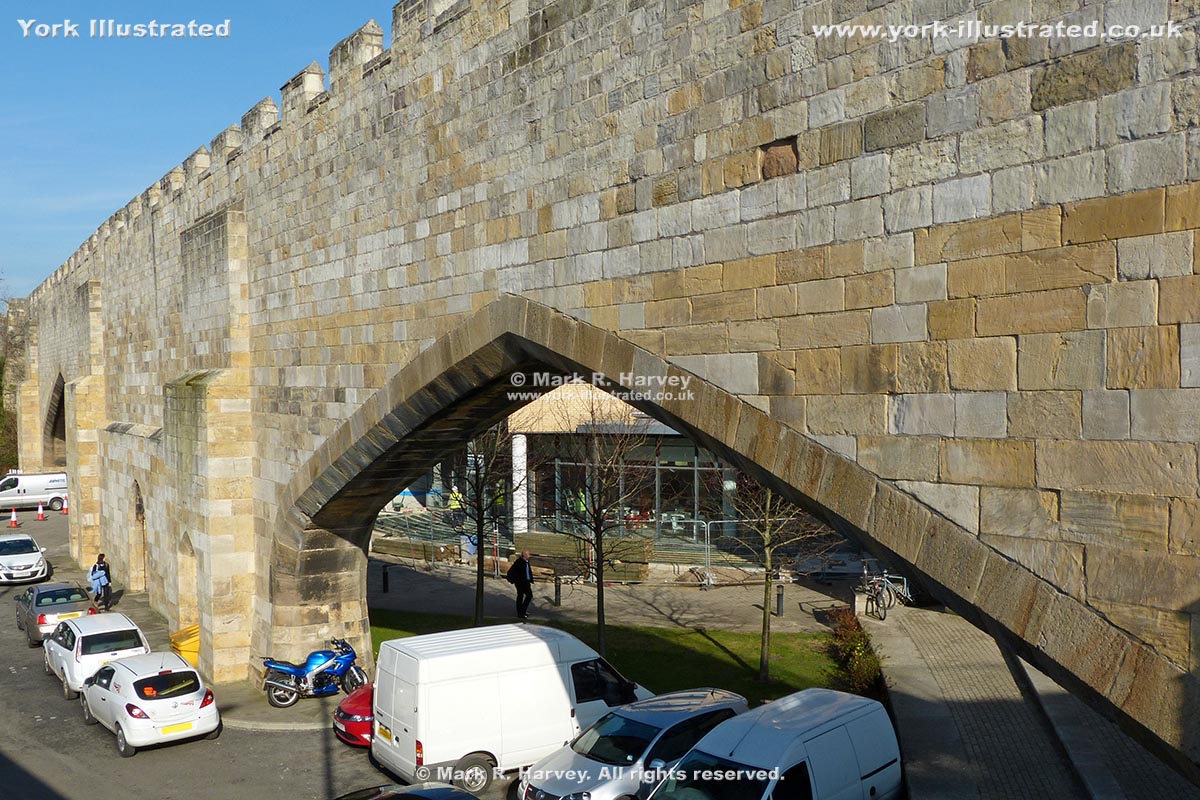
Image A2

Image A3

Image A4

©The Trustees of the British Museum (asset no. 1613428407 - see footnote 1).
The large train arches
The pair of 70 feet wide four-centered 'Tudor' style train arches were constructed in two phases to a design by George Townsend Andrews (the York-based architect responsible for the other buildings associated with the 'old railway station'). The north-eastern train arch was built in July 1839 to facilitate the construction of the station. The south-western train arch was added in 1845 to improve access to the old station's goods facilities. Each of the train arches is flanked by a pair of what appear to be blind 'tudor' style arches, three of which are set into wide buttresses or faux interval towers (see Image A1). The buttresses add strength to this very high section of rebuilt wall, but the blind arches were probably added purely for decoration. Before work commenced, the design was reviewed and approved by the Yorkshire Philosophical Society.
The small central arch
There is also a small (usable) access arch located approximately midway between the two train arches (see Image A2). This was probably inserted for use by pedestrians and / or the horse & cart traffic associated with the goods yard. The stonework forming this central archway appears to have great age and the design of the arch differs significantly from the design of the adjacent train arches. The small central arch has multiple 'orders', a slightly pointed head and what appears to be a pair of vertical slots for a portcullis (see Image A3). It is carved from Magnesian limestone and is broadly similar in design to Fishergate Postern, so it may have been relocated from elsewhere in the city. One possibility is that it was created using stone recovered during the dismantling of the 'Lounlith' (an ancient gateway discovered during the construction of Victoria Bar in 1838). This is pure speculation on the part of the author, but the hypothesis is supported by the following facts:
- The dimensions of the structure. (The small arch is approximately 8 feet wide by 6 feet 6 inches high at the springing point of the arch and these are the dimensions quoted in contemporary accounts for the old arch discovered on the site of Victoria Bar.)
- The proximity of the dates. (The Lounlith was discovered and dismantled in 1838; the first train arch was created the following year and contemporary artwork suggests that the small arch may have been inserted as part of these construction works.)
- The connection with George Hudson - see Image A4. (Hudson became chairman of the York & North Midland Railway Company in 1837 and he was Lord Mayor of York for both 1837-8 and 1838-9 - a fact still commemorated on the datestone above Victoria Bar.)
- The contemporaneous campaign by influential local people to preserve and restore the city walls and other key historic structures.
- The involvement of Charles Wellbeloved (a contemporary local historian, well respected local archaeologist and one of the founders of the Yorkshire Philosophical Society).
Archaeology
During the construction work for these railway arches, a wide variety of archaeological items were discovered. Workmen creating the first train arch found the skeletal remains of numerous humans, horses and other animals in the redeposited soil of the rampart (earth bank). A few years later (during the construction of the second train arch), a collection of grave goods was discovered: these included a bone comb, a bronze lamp handle and a bronze ring. William Hargrove (a well-known author and contemporary York resident) provides us with a description of two more interesting finds from this site:
On Wednesday, the 29th of May, 1839, the York and North Midland Railway was formally opened ... .
About the middle of June, 1839, the workmen employed in forming the arch under the Bar Walls, near Toft Green, found two large stones, with sculpture upon each one representing a Roman Standard Bearer, with a lesser figure near him carrying a measure for corn, as exhibited in the annexed engraving.
The other represents the head of a horse at one end, and the head of a dog at the other ... .
They were removed to the Yorkshire Museum, where they now may be seen.
Source: Hargrove, William: "A New Guide for Strangers and Residents in the City of York", published in York in 1844.
The accompanying illustrations are reproduced below:
Image B1

(An illustration from William Hargrove's book, as cited above.)
Image B2
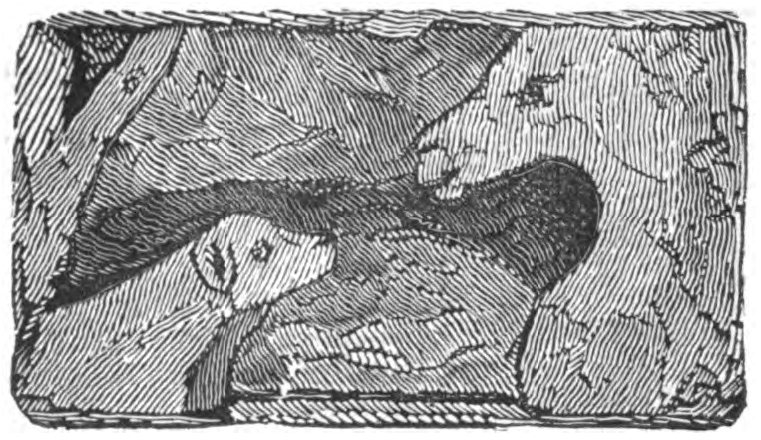
(An illustration from William Hargrove's book, as cited above.)
Charles Wellbeloved describes another set of equally fascinating items unearthed nearby:
Very recently, in the spring of 1841, when workmen were removing the earth to the depth of three or four feet, and to a considerable extent, just without the walls, extra muros, . . . for the purpose of forming the North of England Railway, several Roman coffins containing lime were discovered, but the skeletons in no case entire; the impression of the body was in some instances observable: a specimen of which is placed in the Museum of the Yorkshire Philosophical Society.
Source: Wellbeloved, Charles: "Eboracum, or York under the romans", published in York in 1842, page 109.
Footnotes
[1] This image is a 'derived work' based on a digital image file downloaded from the British Museum's online catalogue, which can be accessed via the following external link:
https://www.britishmuseum.org/collection
To create the version used on the York Illustrated website, the original image was desaturated, the colour temperature levels and contrast were adjusted and the image was resized. The original image and this version are both © The Trustees of the British Museum and both are subject to the CC BY-NC-SA 4.0 license - see:
http://creativecommons.org/licenses/by-nc-sa/4.0/
The original print includes the following text below the image:
Painted by Francis Grant, A.R.A.,
Sussex Villa.
Engraved by George Raphael Ward,
31, Fitzroy Square.
According to the catalogue entry, the print was published on July 25, 1848, by Paul & Dominic Colnaghi & Co. 13 & 14, Pall Mall East, London, and by R. Sunter, York.